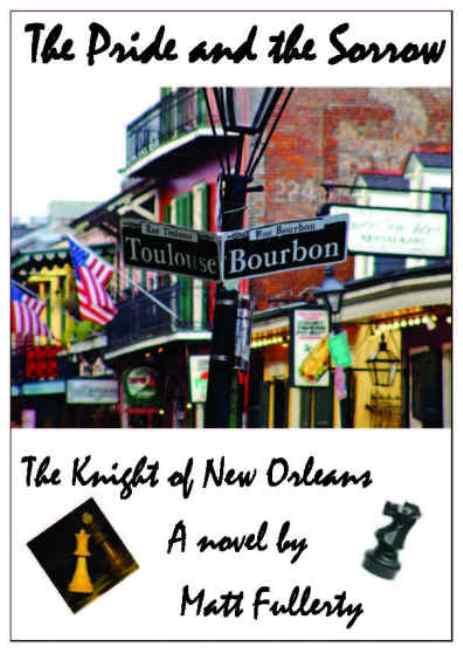
My novel about love, betrayal and chess in New Orleans: The Pride and the Sorrow

Showing posts with label Chess. Show all posts

Thursday, October 22, 2009

James Bond and Chess


James Bond and Chess


"The two faces of the double clock in the shiny, domed case looked out across the chess-board like the eyes of some huge sea monster that had peered over the edge of the table to watch the game. The two faces of the chess clock showed different times."

With these words Ian Fleming opens chapter 7 of FROM RUSSIA WITH LOVE. In 1963 this novel became the second film in the perennial James Bond series.

But there's not much 0-0 in 007 -- or much chess in most chess fiction, for that matter. The book only tells us that grandmaster Kronsteen, a secret agent of the deadly SMERSH, won this game after introducing "a brilliant twist into the Meran Variation of the Queen's Gambit Declined to be debated all over Russia for weeks to come."

The position on a wallboard in the movie is based on an intruiging King's Gambit won by Boris Spassky against David Bronstein at the USSR Championship in 1960. Here it takes place at the Venice International Tournament where Kronsteen ignores a courier's sealed message ordering him to stop play on the spot. He knows he risks his life if he fails to obey, but how many players can abandon a sure win?

At his own peril Kronsteen waits three more minutes to accept his opponent's resignation; but later he must explain to his superior why he did not obey at once. In the book his excuse is accepted reluctanctly:

"To the public, Comrade General, I am a professional chess player. If, with only three minutes to go, I had received a message that my wife was being murdered outside the door of the tournament hall, I would not have raised a finger to save her. My public know that. They are dedicated to the game as myself. Tonight, if I had resigned the game and had come immediately upon receipt of that message, 5000 people would have known that it could only be on the orders of such a department as this. There would have been a storm of gossip. My future comings and goings would have been watched for clues. It would have been the end of my cover. In the interests of State Security, I waited three minutes before obeying the order. Even so, my hurried departure will be the subject of much comment."

In the real game Spassky gambled by rejecting the prudent 15 Rf2. Black in turn missed the best defense by 15...exf1/Q 16 Rxf1 Bxd6 17 Qh7 Kf8 18 cxd6 cxd6 19 Qh8 Ke7 20 Re1 Ne5 21 Qxg7 Rg8 22 Qxh6 Qb6 23 Kh1 Be6 24 dxe5 d5 25 Qf6 Kd7 and the king trips to safety with a possible draw in the offing.

Later if 17...Kxf7? (necessary is 17...Qd5 18 Bb3 Qxb3) 18 Ne5 Kg8 19 Qh7! Nxh7 20 Bc4 Kh8 21 Ng6 mate.

White: BORIS SPASSKY Black: DAVID BRONSTEIN King's Gambit 1960 1 e4 e5 2 f4 exf4 3 Nf3 d5 4 exd5 Bd6 5 Nc3 Ne7 6 d4 0-0 7 Bd3 Nd7 8 0-0 h6 9 Ne4 Nxd5 10 c4 Ne3 11 Bxe3 fxe3 12 c5 Be7 13 Bc2 Re8 14 Qd3 e2 15 Nd6!? Nf8? 16 Nxf7 exf1/Q 17 Rxf1 Bf5? 18 Qxf5 Qd7 19 Qf4 Bf6 20 N3e5 Qe7 21 Bb3 Bxe5 22 Nxe5 Kh7 23 Qe4 Black resigns

Source: Evans On Chess. June 30, 1995. From Chess Connection

Sunday, October 18, 2009

From Gambit: Where was the Paul Morphy Chess Club?

WHERE WAS THE PAUL MORPHY CHESS CLUB?

Blake Pontchartrain

Hey Blake,

Ronnie Virgets wrote a wonderful column on the history of Paul Morphy. My question is: where was the Paul Morphy Chess Club? I can remember an uncle of mine speaking of it often as a place where men met for lunch, cards and cigars.

Kenny Mayer

Dear Kenny,

Virgets' story ("Chairman of the Board," News Views, May 6, 2008) about our local chess genius who died in 1884 at age 47 was excellent.

Morphy was the first great American-born chess player. He traveled to Europe in the 1850s, defeating all challengers except the English champion of the time, Howard Staunton, who refused to play him. Morphy, however, still was hailed as the chess champion of the world.

Paul Morphy Chess Club in New Orleans had several locations, the first in the Balter Building, in the block surrounded by Commercial Place, Camp Street, and St. Charles and Poydras avenues. The last was at 316 St. Charles Ave.

The club was organized in May 1928, when several chess-playing gentlemen agreed to form a new club devoted exclusively to the game. Members were solicited, and the club soon had officers and a charter. New members decided to name the club after the local chess master they so revered. The club opened its doors to members for play on June 22, 1928, Paul Morphy's birthday. There is no longer a chess club by this name in New Orleans, but there are several in America, and there's even a Paul Morphy Chess Club in Sri Lanka.

An earlier group called New Orleans Chess Club was founded in 1841, but it languished due to lack of interest. Later, many New Orleanians became interested in the game when young Paul Morphy burst on the scene. By the mid-1850s, the club sponsored weekly tournaments and membership increased rapidly. Morphy himself was elected president of the club in 1865. Earlier, when Morphy went to Europe in June 1858, the New Orleans Chess Club offered to pay his way. Morphy declined because he did not want to be considered a professional chess player.

Another famous club in the Crescent City was the New Orleans Chess, Checkers and Whist Club. This organization was founded in 1880, shortly before Morphy's death. The club first met in July in a room at 128 Gravier St. There were 27 members. It was an immediate success and membership grew rapidly. New quarters had to be found, so the group relocated to Common Street and then to a three-story building at the corner of Canal and Baronne streets.

Then disaster struck: A fire in 1890 burned the building to the ground. Lost in the fire was invaluable Morphy memorabilia. The owner of the structure agreed to rebuild, and soon the club was re-established in comfortable surroundings on the third floor. At this point, there were more than 1,100 members.

In 1920, another move brought the club to 120 Baronne St., where the men played various games in splendor. It occupied four floors in a large building, which had many rooms for games, as well as dining rooms, a billiard hall, a library and bedrooms for men who lived at the club.

It was after the death of Judge Leon Labatt - a strong supporter and member of the New Orleans Chess, Checkers and Whist Club - and a number of resignations that the members decided to form a new group: the Paul Morphy Chess Club.

Morphy retired from chess long before his death. He played absolutely no games of chess with anyone after 1869.

--

To read my chess novel about Paul Morphy's life, please see this link.


Friday, October 16, 2009

Chess Book of the Year, part 3


Ronan Bennett & Daniel King
Tuesday October 13 2009
The Guardian

--

Gligoric-Nikolic, Novi Sad 1982. Black to play. Who stands better?

RB Our third shortlisted book for the Guardian Chess Book of the Year award is Winning Chess Middlegames by Ivan Sokolov (New in Chess, GBP 24.95). Like our first shortlisted title, Chess Strategy for Club Players by Herman Grooten, Sokolov's book focuses on the middlegame, but whereas Grooten emphasises the dynamic aspects of the game, here the stress is on pawn structure. In an introduction Michael Adams makes the point that we often learn opening lines without giving serious thought to the kind of pawn structures they create.

Sokolov arranges his material into four different types of pawn structure: doubled pawns; isolated pawns; parallel hanging pawns in the centre; and pawn majority in the centre, further dividing these into subgroups. He then analyses the structures with reference to the opening. Chapter 1, for example, deals with doubled pawns arising mainly from the Nimzo. Chapter 2, on isolated pawns, looks predominantly at lines in the Queen's Gambit Declined. The essential point - but one often overlooked - is that from the opening we should be able to anticipate the structure of the middlegame.

The diagram position arose out of a Nimzo (H?bner Variation), with the characteristic doubled pawns on c3 and c4. White has tried to exploit the semi-open b-file to create threats against the enemy king. His rooks are doubled, the bishop is on b5, and the queen lurks on a3. On the other wing, Black's pawns are advancing, supported by the rooks. Who stands better?

Fritz assesses the position as roughly equal. But Sokolov is unequivocal: "A sorry sight. On the queenside White is not able to create a single threat, while on the other side of the board the battle is lost." The computer is wrong. White is dead lost. After Black's simple defensive expedient 1...Na6-b8, the game continued 2 Nf1 g4 3 f4 exf4 4 Bxf4 Ng6 5 Rf2 h4 and the pawns quickly smashed the white king's position.

--

guardian.co.uk Copyright (c) Guardian News and Media Limited. 2009


Wednesday, October 14, 2009

Chess Book of the Year, part 2: Kasparov vs Karpov

Ronan Bennett & Daniel King
Tuesday October 6 2009
The Guardian

--

Smyslov-Botvinnik, 5th game World championship 1958. Black's king is in check. Should it move up to c5 or back to c7?

DK Two books on world championship matches made it on to our shortlist for book of the year. Kasparov vs Karpov 1986-1987 (Everyman Chess, GBP 30) written by Garry Kasparov, is an automatic choice. This is the latest volume in the former world champion's monumental series, and this time he dissects the matches in London/Leningrad 1986 and Seville 1987.

Kasparov's detailed analysis of the games is admirable but I skimmed them and just read the story ? it's gripping. Gorbachev had just come to power and was implementing his policies of glasnost and perestroika in the face of conservative opposition. In that context the result of these matches had enormous significance: Kasparov was the outspoken outsider, Karpov the loyal communist. Which image would the Soviet Union be projecting to the world? Kasparov alleges - and backs up with strong evidence - that there were spies in his camp passing information to Karpov, backed by the KGB. Some of the episodes could have come straight from the pages of a le Carré novel.

Botvinnik-Smyslov, Three World Chess Championship Matches: 1954, 1957, 1958 (New In Chess, GBP 28.95) is another reminder of a great chess rivalry. The annotations are mainly by Botvinnik and are characterised by his typical "objectivity" (read harshness). These notes were, of course, written in the pre-computer era, which means fewer variations than many contemporary books. That's a relief. I'd rather have a few well-chosen words than blocks of indigestible moves.

In the position above, Botvinnik was short of time and played the reflex 1? Kc5, following the general rule that kings should be as active as possible in the endgame. But Smyslov replied with 2 Kd3, and checkmate with b4 was unavoidable. Black should have tried 1?Kc7, and he still had chances to save the game.

--

guardian.co.uk Copyright (c) Guardian News and Media Limited. 2009


Tuesday, September 15, 2009

"Queen to Play" - film review - checkmate!

Film Reviews
Queen to Play -- Film Review
By Frank Scheck, April 27, 2009 05:39 ET


Bottom Line: Some good moves, but no cinematic checkmate.
More Tribeca reviews

NEW YORK -- Chess as metaphor for life is the theme of Caroline Bottaro's French drama starring Sandrine Bonnaire as a maid who rediscovers herself thanks to her newfound love for the game and Kevin Kline as the misanthropic recluse who teaches her. While "Queen to Play" boasts an admirable dramatic subtlety and several strong performances, its overly familiar ideas and lugubrious pacing, as well as the fact that chess is not exactly the most cinematic of subjects, will make it a tough sit even for dedicated art house audiences. It recently received its world premiere at the Tribeca Film Festival.

Bonnaire plays Helene, a chambermaid at an upper-class Corsican hotel who's dealing with financial problems, a rebellious daughter and a less than ideal marriage to a handsome but not particularly sensitive blue-collar worker (Francis Renaud).

When she sees a glamorous, barely clothed couple (including Jennifer Beals in a cameo) intensely playing chess on their balcony, it stirs something within her. She promptly buys a set, but her husband proves to be an unwilling player. Spotting a board in the home of Dr. Kroger (Kline), for whom she moonlights as a cleaning person, she implores him to tutor her in its intricacies.

Kroger, who has barely spoken to her in all the time she's worked for him, initially rebuffs. But sensing her passion, he eventually agrees, and the two begin weekly sessions in which the pupil soon starts overshadowing her teacher. By the time she's allowed to participate -- in underdog "Rocky" fashion -- in a local tournament, all the principal characters have undergone life-enhancing emotional changes.

That the film works to the degree that it does is largely due to the sensitive performances. Bonnaire delivers a beautifully modulated turn, delineating Helene's liberating transformation in quietly powerful and convincing fashion. Kline, in his first entirely French-speaking role, intriguingly underplays as the mysterious Kroger, and Francis Renaud strongly conveys the husband's complicated feelings of disdain for his wife's new obsession and concern for his marriage.

Production: Mon Voison Prods
Cast: Sandrine Bonnaire, Kevin Kline, Francis Renaud, Jennifer Beals, Valerie Lagrange
Director: Caroline Bottaro
Screenwriters: Caroline Bottaro, Caroline Maly, Jeanne Le Guillou
Producers: Dominique Besnehard, Micher Feller, Amelie Latscha
Director of photography: Jean-Claude Larrieu
Editor: Tina Baz
Production designer: Emmanuel de Chavigny
Music: Nicola Piovani
No MPAA rating, 96 minutes

Queen to Play -- Film Review

By Frank Scheck, April 27, 2009 05:39 ET


Monday, August 31, 2009

Howell Wins British Chess Championship at 18

Leonard Barden
Saturday August 8 2009
The Guardian
---
David Howell, 18, triumphed with an unbeaten 9/11, seven wins and four draws, in the British Championship at Torquay. The teenager from East Sussex is already the youngest ever UK grandmaster and is now the second youngest British champion after Michael Adams, who won the title at 17.

Howell rode his luck in some games, notably in round two when Mark Hebden missed an instant win, but overall his total was an impressive performance which suggests he can improve to join Adams and Nigel Short at the top of the game.

Howell first hit the headlines at the age of eight when he beat the grandmaster John Nunn in a speed game, a world age record. At nine, he became the youngest to qualify for the British Championship final tournament and three years later, he drew a speed game against the then world champion Vladimir Kramnik. He took his A levels early and has improved rapidly for the past year. In 2008 he was beaten in the final round of the world junior (U20) championship and he will try again for the title at Mar del Plata, Argentina, in October.

Today, Howell joins England's optimum team, led by Adams and Short, for a 10-round match against the Netherlands at Simpsons in the Strand, London. Play is every afternoon until 17 August and spectators can watch for free. The legendary Viktor Korchnoi, 78, competes in an individual event.

Below the game was complex but level until Black blundered by 21...Rd8? (Bb5+ 22 c4 Bc6) and had to resign three moves later faced with heavy material loss.

D Howell v R Palliser

1 d4 Nf6 2 Bg5 d5 3 Bxf6 gxf6 4 e3 c5 5 dxc5 e6 6 Nd2 Bxc5 7 g3 Nc6 8 Ne2 d4 9 exd4 Qd5 10 dxc5 Qxh1 11 Nc3 Qxh2 12 Nde4 O-O 13 Qd2 Rd8 14 Nxf6+ Kh8 15 Qg5 h6 16 Qg4 Qh1 17 Rd1 Rxd1+ 18 Nxd1 Bd7 19 Ne3 Ne5 20 Qf4 Nf3+ 21 Ke2 Rd8? 22 Bg2 Ng1+ 23 Kf1 Qh2 24 Nfg4 1-0

Lower down the table the rising Durham expert Jonathan Hawkins, 26, scored an IM result as he did in 2008. Here his sharp 12 Kf1 varies from 12 Bd2. Black should have tried 15...Bxd4 16 Nxd4 Nxd4 when the N stops the deadly Qf3. Black's Rd7? fell for mate when 19...Rf8 20 Bh6 Bd7 held out longer.

J Hawkins v S Sen

1 d4 Nf6 2 c4 g6 3 Nc3 d5 4 cxd5 Nxd5 5 e4 Nxc3 6 bxc3 Bg7 7 Bc4 c5 8 Be3 O-O 9 Ne2 Nc6 10 Rc1 cxd4 11 cxd4 Qa5+ 12 Kf1!? Qa3 13 Rc3 Qd6 14 h4 Rd8 15 h5 Nxd4? 16 Nxd4 Bxd4 17 hxg6 hxg6 18 Rd3 e5 19 Qf3 Rd7? 20 Bg5 Kg7 21 Qh3 1-0

3099 1...Rf4! 2 Rxc7 Qh6! and White resigned due to 3 Rxd7 Rh4 and Rxh2+.

---
guardian.co.uk Copyright (c) Guardian News and Media Limited. 2009


Sunday, August 30, 2009

Paul Morphy, Chess Player, World Champion!


Thursday, August 27, 2009

Why chess is a perfect game for fiction - KGB chess!

Stuart Evers
Friday August 28 2009
The Guardian
---
The summer of 1972 is a golden one for writers seeking a tumultuous background to their fiction. Kicking off with the breaking of the Watergate scandal, continuing through "Hanoi" Jane Fonda's tour of North Vietnam and ending with the massacre at the Munich Olympics, that summer is stuffed with so many huge international events that a humble game of chess seems rather a distraction. But this was the match between Boris Spassky and Bobby Fischer - and the whole of the cold war world was watching.

The central character in David Szalay's second novel, The Innocent, however, has to content himself with listening on the radio. A former hardliner and former member of the nascent KGB, Aleksandr sets up his battered and broken chess set and moves his little chess pieces according to the increasingly tired voice calling the action from Reykjavik. It's just four pages long, this scene, but Szalay imbues it with a stillness and a tension that is taut and increasingly expressive.

The broken board, the chessmen wrapped in a newspaper reporting a decade-old east v west crisis, the frown on Aleksandr's face as he fails to spot Fischer's error: all of these images, when taken together, perfectly articulate the internal combat waging in Aleksandr's head. His faith in the great experiment is failing, yet chess is there to remind him where his allegiance lies. The section ends with a simple, yet effective, conclusion: Aleksandr is looking at the board, staring at the "silent little pieces of wood whose significant positions are tonight transfixing the world."

Even without the backdrop of political schisms and the spectre of mutually assured destruction, chess is a transfixing game in its own right - especially for writers. It has been the inspiration for countless novels, plays and pieces of short fiction, many of which are collected in a wonderful anthology called The 64-Square Looking Glass. What is it that makes chess such a consistently fascinating subject?

Chess, by its very nature, is a battle between two different thought processes; it gives the novelist the opportunity to go into the players' minds, while retaining an element of plot at the same time. This approach is brilliantly explored in Carl Haffner's Love of the Draw by Thomas Glavnic, a novel as strikingly good as its title. Here, 10 games of chess - which become ever more gripping as Haffner tries desperately to avoid losing - are the springboard to a familial history and an elegy for a disappearing Vienna. It's one of chess's finest novels, sitting comfortably alongside Nabokov's The Luzhin Defense and Paulo Maurensig's The Lüneburg Variation.

More abstractly, chess is attractive to writers as it mirrors the very act of writing itself. Planning ahead, tactics, manipulation are both part of fiction's palate as well as chess's. In both his fiction and his plays, Beckett used the imagery of the chess set, moving his characters around like lowly, articulate pawns. The conclusion of Murphy may be the finest expression of the game's intrinsic link to both art and humanity - "The ingenuity of despair" indeed.

Taking Beckett to its postmodern conclusion, Martin Amis's Money featured a chess game between the central character, the plumply odious John Self, and the spitty, roll-up smoking "Martin Amis". It's an extraordinary scene and one that despite my general loathing of his style and subject matter, I must concede is brilliantly written, controlled and executed. It's the only time where I could see what the fuss was all about, especially at the game's close when "Amis" apologises, as much for creating him as for beating Self at the board.

While Szalay's novel is far from the glitzy literary chicanery of Amis, The Innocent does, like Money, pivot around its respective chess scene. And while Self is playing his creator, Aleksandr is playing out other people's moves as well as his own personal demons. Neither are chess men, yet this is the game they play - for no other has the weight and heft to support such an important part of a novel.

---

guardian.co.uk Copyright (c) Guardian News and Media Limited. 2009


Tuesday, August 25, 2009

Chess and the KGB novel - "an exciting and memorable read"!

Viv Groskop
Sunday August 23 2009
The Observer
---
Spring 1948 and Aleksandr, a KGB major, is sent to an isolated psychiatric clinic in the Urals to investigate Anatoly Yudin. A famous pianist in the 1930s, Yudin disappeared during the Second World War and was presumed dead. Now he has resurfaced and has a strange form of amnesia. Or does he? Aleksandr suspects Yudin may be writing anti-Soviet tracts. Does Lozovsky, Yudin's doctor, know something? The story is told by Aleksandr, looking back from 1972 as he begins to see the whole of Soviet history - and the role he has himself played - in a different light.

With Aleksandr, David Szalay, winner of the Betty Trask Prize 2008 for his debut London and the South-East, has created an extraordinary character, a KGB man you can imagine knowing or even being. Aleksandr is an idealist, a "real" communist, who truly believes in the system and wants to do the right thing. Anyone who has seen the German film The Lives of Others will recognise the type: he's a cousin of Stasi Captain Gerd Wiesler, another Everyman who suddenly finds himself questioning everything he has ever believed.

This, then, is a similar situation in Soviet form. Szalay's trick is to make us feel for Aleksandr and sympathise with his dilemmas, while inserting the odd chilling clue as to what's really going on. ("Turn off his light," he says to the officer guarding a man under interrogation and we suddenly realise the conditions the prisoner has been kept in.) Aleksandr's journalist brother, Ivan, offers a foil to the ideological purity; he is prepared to take risks and sees the flaws in the system ? until he becomes a beneficiary of it himself. Over the course of the book, the two brothers swap roles, with Aleksandr becoming more disillusioned and Ivan happily riding the gravy train.

The novel's focus swings dramatically between the two brothers' changing relationship and the fate of Yudin and Lozovsky, until we, like Aleksandr, are no longer sure who's in the right, who is supposedly guilty and who really has done something wrong. The result is not so much a critique of the Soviet system - or of totalitarianism - as a comment on the uncertainty of life, how little we know others or even ourselves.

Woven into the narrative are fascinating accounts of historical moments, seen through the eyes of ordinary Soviets, which gradually affect Aleksandr's mindset: losing to the Germans 3-0 at football in the 1972 European Championship final; Bobby Fischer beating Boris Spassky at the Reykjavik chess championships. When Aleksandr's KGB mentor, a man whom he considers to be as trustworthy and "pure" as himself, is targeted, his world implodes. Meanwhile, there are scenes of quiet, comic desperation from everyday Soviet life. The KGB officer supposed to be intercepting Lozovsky falls asleep at his post. In a communal flat, people find themselves involuntarily registering what their neighbours last had to eat and when they last smoked a cigarette.

This is an exciting and memorable read. Expertly researched, it feels authentic, but wears its learning reassuringly lightly. Anyone who appreciated Martin Amis's Koba the Dread and Orlando Figes's The Whisperers will love it, as will fans of The Lives of Others or Burnt by the Sun. As with both films, the theme of silent, regret-filled horror is beautifully, chillingly captured.

---

guardian.co.uk Copyright (c) Guardian News and Media Limited. 2009


Thursday, August 13, 2009

Are you a fan of chess and New Orleans?

Matt Fullerty's Facebook profile


Matt Fullerty on Facebook


Wednesday, June 10, 2009

Matt Fullerty - author fan site!

Matt Fullerty on Facebook


Friday, June 5, 2009

The Knight of New Orleans - chess in the crescent city!


Tuesday, June 2, 2009

Novel's first review - thanks Geoff!

Geoff Cush, New Zealand novelist and a member of the Bookhabit judging panel, had this to say about THE PRIDE AND THE SORROW:


"What made Matt Fullerty's writing stand out, from the very first sentence, was an unusually strong and individual way with words. Taking us into the vanished world of old America and Europe he uses a highly textured language to give an almost physical experience of being in that place and time. Drawing subtle lines between a society top-heavy with leisure and the profligate genius it produced in Morphy, he holds back the historical and personal reckoning while letting it gather and brood like the storm that finally washes away New Orleans. In my view this makes THE PRIDE AND THE SORROW a stand-out all rounder in the craft of literary fiction."

This smart-looking chap is Paul Morphy. You can follow this link to find out more about his New Orleans family. And to learn more about his formidable chess opponents with slideshows of the players click here!

Tuesday, May 19, 2009

Screenplay complete!


I am pleased to say I've now completed a screenplay for my novel The Pride and the Sorrow.

To distinguish it from the novel, I've called the screenplay The Knight of New Orleans. It's currently with the Film and TV agent Meg Davis, Director of MLA Literary Agents in London.
I also took the move of registering The Knight of New Orleans with the Writer's Guild of America, East as proof of copyright. Copyright is immediately assigned to the originator at the point of writing, so registering any work (or mailing it to yourself in a sealed post-stamped envelope) has to be a wise move.

I look forward to The Knight of New Orleans being sent out in 2009!


Tuesday, May 5, 2009

Matt wins Unpublished Novel Competition

Bookhabit.com is pleased to announce the winner of the inaugural Bookhabit Unpublished Competition is Matt Fullerty's The Pride and the Sorrow. Matt receives a US$5000 prize and is "thrilled" about winning the first Bookhabit competition. We will be posting an interview with Matt on Bookhabit.com shortly. Congratulations from Bookhabit! You can see full details with an endorsement of the novel at http://www.bookhabit.com/newsdetail.php?nid=48

The Pride and the Sorrow is the story of Paul Morphy (1837-1884), born in New Orleans as a chess prodigy, his famous journey through Europe and his ultimate downfall on and off the chessboard. He is celebrated in fashionable European society, honored by Napoleon III of France and Queen Victoria of England and returns to New Orleans a local celebrity, only to find Civil War looming, a storm brewing in his family and his own mind coming apart ...


The novel itself is available at http://bookhabit.com/book_details.php?book_id=459


Wednesday, April 22, 2009

Faulkner-Wisdom Competition - I am "Almost Finalist"!

I'm pleased to say The Pride and the Sorrow is an "Almost Finalist" in the 2008 Faulkner- Wisdom Competition. The competition is run by the Pirate's Alley Faulkner Society, and was judged by former Random House VP, Michael Murphy.

Thanks Faulkner Society!

My novel about painting, criminality, and the greatest art forger of the twentieth century!

My novel about painting, criminality, and the greatest art forger of the twentieth century!
Please click the cover!

My novel about London, murder, mayhem, and a female killer!

My novel about London, murder, mayhem, and a female killer!
Please click the cover!

My novel about running, Princeton University, and a conman who lost it all!

My novel about running, Princeton University, and a conman who lost it all!
Please click the cover!

My novel about running, Princeton University, and a conman who lost it all!

My novel about running, Princeton University, and a conman who lost it all!
Please click the cover!

My novel about love, betrayal and chess in New Orleans

My novel about love, betrayal and chess in New Orleans
Please click the book!

My semi-autobiographical novel about a very British education and becoming an American!

My semi-autobiographical novel about a very British education and becoming an American!
Please click the cover!

My novel about London, murder, mayhem, and a female killer!

My novel about London, murder, mayhem, and a female killer!
Please click the cover!