My novel about love, betrayal and chess in New Orleans: The Pride and the Sorrow

Showing posts with label Crime. Show all posts

Thursday, October 28, 2010

Crime Novel Becomes Reality for GW English Professor!

GW Professorial Lecturer in English Matt Fullerty, who is currently teaching ENGL 62 (Comedy) and ENGL 52W (English Literature), recently found himself in the middle of a national news story in the UK.

Last weekend, a human skull was dug up in the garden of broadcaster/naturalist Sir David Attenborough in London. It turns out to be the long-missing head of an 1879 murder victim named Martha Thomas, who was killed by her maid Kate Webster.

In a peculiar twist, Dr. Fullerty has been writing about the murder--in the form of a novel--for the past two years. After the murder, Kate impersonated Martha Thomas around London, wearing her clothes and jewelry, and selling her victim's belongings. After trying to flee to Ireland, Kate was arrested and put on trial at the Old Bailey, eventually confessing to her priest. She was hanged in Wandsworth Prison by the "royal hangman" William Marwood on 29 July, 1879.

When the story broke on Saturday in England, Matt became the go-to source for the British press. The result was a feature in Tuesday's Daily Mail about life of the killer (and the man who hanged her).

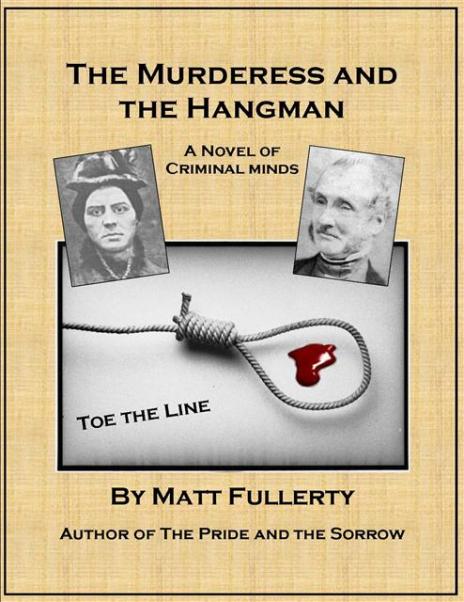
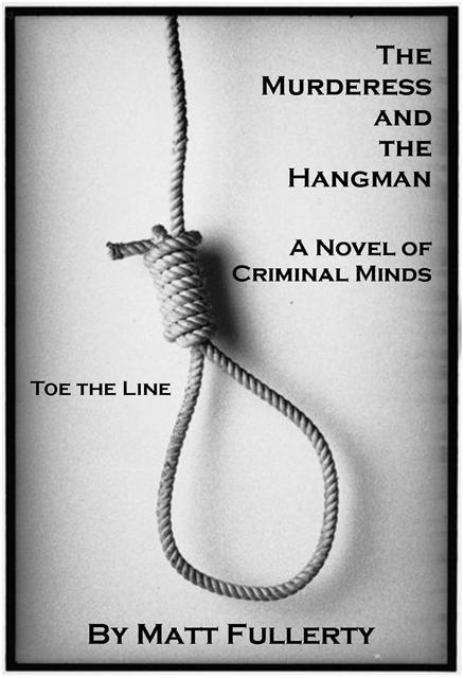
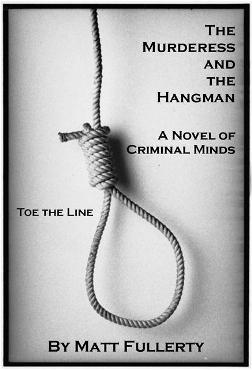
You can read more about Matt Fullerty's novel The Murderess and the Hangman here. Matt is currently looking for a publisher for his work, and we hope this strange turn-of-events will help him land a book deal in time for Halloween!

Tuesday, October 26, 2010

How a skull found in David Attenborough's garden has solved one of Victorian Britain's most gruesome murder mysteries

Attenborough

On a bright, spring morning, coal porter Henry Wheatley and his companion were driving their horse and cart along the Thames.

Shortly before seven o'clock, just before arriving at Barnes Bridge, South London, Wheatley noticed a wooden box lying half-submerged in the water.

He got down from his cart and, with some difficulty, hauled the box on to the bank. Noticing that it was tied with cord, Wheatley took out his knife and cut it open.

He then gave the box a kick and it collapsed. What he saw next turned his stomach. A mass of white flesh fell to the ground. At first, Wheatley's companion suggested they'd stumbled across a box of butcher's offcuts.


Workmen building an extension at the Richmond home of Sir David Attenborough unearthed a skull in the naturalist's garden. The police are almost certain it is that of Mrs Thomas, who was murdered 130 years ago
But Wheatley knew his find was far more grisly  -  in fact, he'd stumbled across the body parts of a dismembered woman. The date was March 5, 1879. Wheatley immediately reported his find to the police at Barnes.

A pathologist identified the body parts as belonging to a short, somewhat tubby woman.
The corpse had been cut up with an ordinary meat saw, and a contraction of flesh away from some of the bones suggested that the pieces had been boiled.

However, the body was missing not only a foot, but also something vital to help with identification  -  its head.
Five days later, another gruesome discovery was made  -  this time on a manure heap in an allotment in Twickenham, about five miles from Barnes. It was a box containing the missing foot, which had been boiled in the same way as the rest of the corpse.

For the next few days, the police could only guess as to the identity of the body  -  which some newspapers speculated could have been used by medical students for dissection.

However, by the end of the month and with help from a key witness, the police and the public learned the body belonged to a 50-year- old woman called Julia Martha Thomas, who lived in Richmond.

Kate Webster
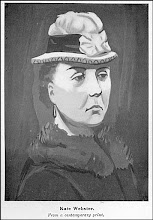
Kate Webster - who murdered her elderly employer with an axe after she returned home from church on a Sunday evening

She had been murdered by her servant, a 30-year-old Irish woman called Katherine Webster.
Because of the gruesome nature of the corpse, the public were fascinated by the case. Some people even removed pebbles and twigs as souvenirs from the small garden of Mrs Thomas's cottage in Park Road, Richmond.

What was never discovered was Mrs Thomas's head. Its location remaining a secret  -  until last week, a full 130 years later.


On Friday, workmen building an extension at the Richmond home of Sir David Attenborough unearthed a skull in the naturalist's garden, and the police are almost certain it is that of Mrs Thomas.
Should this indeed be the case, then the final chapter of one of the most foul murders in Victorian London can now be written.

As a crime novelist, I've long been fascinated by the tale of the Richmond Murder  -  and I've even written a book based on the killing.

The murderer, Katherine Webster, was born in a small village in County Wexford in 1849. She spent her teenage years in and out of prison. At around the age of 17, she fled to Liverpool, where she lived as a drifter and furthered her skills as a burglar.

However, she soon found herself locked up and was sentenced to four years of penal servitude in 1867.
Released after three years, she made her way south to London, where she apparently attempted to make an honest living.

In 1873, she lodged in Rose Gardens, Hammersmith, West London, next to a family called the Porters, who would play a major part in her fate six years later.

Some time the following year, she gave birth to a son out of wedlock.

Unable to make ends meet Webster once more turned to thieving and, in 1875, she was sentenced to 18 months in London's Wandsworth prison for a staggering 36 offences of larceny.

As soon as she got out, she re-offended, and was locked up for another year in February 1877. In January 1879, she finally appeared to turn her back on a life of crime by taking a job as a servant for Mrs Thomas, at her home in Richmond.

Aged around 50, and recently widowed, Mrs Thomas was a small woman who took her religion seriously and was a devoted worshipper at the local Presbyterian chapel.

Unsurprisingly, the two women did not get along well. Mrs Thomas often had to reprimand her new servant for her violent temper and less than capable serving skills.

Builders unearthed a skull, believed to solve a 131-year-old riddle, in globe-trotter Sir David Attenborough's garden 
Gruesome: Builders unearthed a skull, believed to solve a 131-year-old riddle, in globe-trotter Sir David Attenborough's garden


On the evening of Sunday, March 2, Mr s Thomas returned from an evening service at the chapel. She found Webster had been drinking and a row ensued. The drunken servant girl was unable to contain herself and during the course of the argument she pushed her employer down the stairs.

She ran down after her, and seeing that Mrs Thomas appeared to be badly hurt, she decided to strangle her.
What happened next is like something out of a horror film. For the next 24 hours, Webster cut up the body of Mrs Thomas and boiled the pieces in a big copper pan.

Why she decided to boil the pieces is not clear, but it is likely she was hoping to disintegrate the flesh. She was unsuccessful and her attempts to burn the body parts also failed.

At this point , Katherine Webster decided that the only way to dispose of the body was to parcel it up and throw it in the Thames.

She placed the pieces in a box, and put the box into a large black bag. Then she assumed Mrs Thomas's identity.

On the late afternoon of Tuesday, March 4, she walked to her friends the Porters, whom she had not seen for months, and told them that she was now called Mrs Thomas and that her aunt had left her a house in Richmond.

Webster asked Mr Porter if he knew of an agent who could sell the house for her.

A little later, Webster, Mr Porter and his teenage son Robert went for a drink at a nearby pub. Robert carried the black bag, and it sat under the table while the three had ales.

Then Webster left  -  saying that she had to quickly see someone. When she returned, Porter saw that she no longer had the bag.

In fact, she had thrown it off Hammersmith Bridge.

Webster's greed knew no bounds. As well as trying to sell her victim's house, she also attempted to sell all its contents.

A man called John Church offered her £68 for some of the furniture, and she took £18 as a down-payment  -  insisting it be in cash or gold.

However, Webster was worried her crime would soon be discovered, and on or around March 18 she fled back to County Wexford.

Back in London, John Church began to grow suspicious and tracked down a friend of the real Mrs Thomas, who informed him that she was in fact in her 50s  -  and was most certainly not in her 30s with an Irish accent.
Church informed the police and, with evidence from Church and the Porters, they quickly put the puzzle together. On the 25th, Webster was arrested and detained at Clerkenwell prison.
At her trial that April, huge crowds thronged around the Central Criminal Court in London. Webster was found guilty, although she denied the murder.

She finally confessed the night before she was hanged at Wandsworth Prison on July 29.

What she never admitted was the location of Mrs Thomas's head, a secret which she took to her death at the end of the long rope.

Now, thanks to the unwitting help of Sir David Attenborough, the case can be finally closed.

Matt Fullerty's author site is www.mattfullerty.com

His novel based on the crime, THE MURDERESS AND THE HANGMAN, is currently with Watson, Little Ltd, and looking for a publisher. 

--


Tuesday, June 22, 2010

Is Bernie Madoff 'Free at Last'?


In a recent New York magazine article, writer Steve Fishman sheds light on Bernie Madoff's life behind bars. The lengthy profile reveals a string of insider details, some far more telling than accounts of Madoff's prison rumble back in October.

For starters, the disgraced financier viewed by most as a thief and criminal for swindling an estimated $65 billion in history's worst Ponzi scheme, is regarded as somewhat of a celebrity at the federal correctional complex in Butner, N.C. He has an entourage of "groupies," according to the article, and though he shuns all autograph requests, he has managed to cultivate these relationships over time. Some even go as far as dubbing him "a hero" and turn to him for advice on anything from investing to entrepreneurship.

Then there's Madoff's talent for delegating duties on to others, hiring an inmate to do his laundry for $8 a month -- negotiating a discounted rate nonetheless. On the flip side, Madoff has energetically thrown himself into the prison-work world, even though he's exempted from chores because of his age. Fishman writes:

"He proposed that he serve as the clerk in charge of budget. He had qualifications—he'd been chairman of NASDAQ. 'Hell, no,' said the supervisor to Evans, laughing. 'I do my own budget. I know what he did on the outside.'"

Instead, Madoff was assigned to maintenance and cafeteria floor-sweeping duty.

Perhaps the most startling inclusion in the article is that Madoff reportedly feels little remorse for what he has done. Instead, Fishman suggests he might even be relieved that he is no longer living a lie. The article explains:

"'It was a nightmare for me,' he told investigators, using the word over and over, as if he were the real victim. 'I wish they caught me six years ago, eight years ago,' he said in a little-noticed interview with them."

As for his victims...

"'F--k my victims,' he said, loud enough for other inmates to hear. 'I carried them for twenty years, and now I'm doing 150 years.'"

For an in-depth view on Madoff's life in prison, read Steve Fishman's full article in New York magazine.

--

Message Edited by ReneeDeFranco on 06-09-2010 10:08 AM

Saturday, June 5, 2010

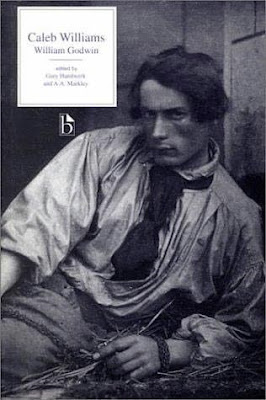
The Book You Have to Read: “Caleb Williams,” by William Godwin


If today’s readers and writers of crime fiction look over their shoulders, who are lurking in the shadows behind Agatha Christie, Raymond Chandler, Dashiell Hammett, Arthur Conan Doyle, and Wilkie Collins? Edgar Allan Poe, of course, and Charles Dickens. As it happens, those two authors met once, in Philadelphia in March 1842, and by a quirk of fate we know one of the subjects they talked about--a third writer, William Godwin, who had died six years before.

It’s an odd, maybe significant coincidence. Godwin is best known today for his novel Caleb Williams, which stands in the shadows behind the shadows--it’s a book that invisibly underpins the genre, The Rap Sheet, and much else. You can even argue that, with Caleb Williams, Godwin invented crime fiction, and that he was the first noir author.

Noir? It’s a big claim, but it holds up.

A cozy crime story takes place in an ideal world where the detective restores perfection by rooting out the murderer who has briefly imposed a blemish on it.

Noir, on the other hand, has the opposite dynamic. It’s set in a fundamentally corrupt world that’s wall-to-wall blemishes, a place where the investigator, for all his flaws, is the best thing available to a morally upright individual. A noir hero can never make the world a wonderful place. Faced with a crime, he can only do his best, according to his lights, and hope he’ll maybe survive until next time. It’s a job description for Caleb Williams.

William Godwin was remarkable by any standards. He was an English anarchist at the time of the French Revolution (which he naturally supported). His first wife, Mary Wollstonecraft, wrote a seminal feminist text. His daughter Mary married poet Percy Bysshe Shelley and wrote Frankenstein (1818). His stepdaughter had an illegitimate child with Lord Byron. Godwin wrote novels partly to make money and partly as vehicles for his philosophical beliefs.

He published Caleb Williams in 1794, five years after the Revolution. It’s not a whodunit, and it’s only a mystery for the first third of the story. But it centers on a crime and murder in Britain, and on the methods and consequences of investigating that murder. It’s a novel of considerable and often uncomfortable psychological penetration. And it’s full of incredibly vivid and realistic snapshots of the world in which its author lived. It’s one of the prototypes of the crime novel not only in the way it concerns a murder but also--as Poe himself noted--in the way it was constructed, from effects back to causes.

The rest of this piece describes the bones of the story. But the bare summary won’t spoil your enjoyment if you read the novel afterwards. It’s the body of this book that counts, not the bones that support it.

Caleb Williams is poor but intelligent. Orphaned at 18, he’s given a job as a secretary by the local squire, Ferdinando Falkland, a man of great refinement who is drawn into a feud with a boorish neighbor. When that neighbor is murdered, Falkland is the chief suspect--but he’s so gentlemanly that his fellow magistrates can’t believe he could commit a sneaky little slaying. Two local farmers are hanged instead.

In the second part of the book, Caleb investigates the murder and, with growing horror, realizes that Falkland not only killed the neighbor but let two innocent men hang for his crime. For many authors, the revelation of the real murderer would be the climax. In fact we’re not even halfway through, and the real climax is yet to come.

At this point, the narrative switches: until now, Caleb has pursued Falkland; but now it’s the other way round. Falkland treats his hapless secretary with increasing hostility: it’s almost as if he transfers the hatred he feels for himself to Caleb, the man who won’t let him forget what he has done.

Caleb’s attempt to expose his master backfires, and he’s flung into jail without trial. His experiences as a prisoner are described in harsh, documentary detail. At last Caleb escapes. But he’s friendless and penniless. The resources of the state and of society are in league against him. And the worst is still on the horizon.

In the last part of Godwin’s novel, Caleb is on the run. Falkland mobilizes the full weight of government authority to hunt down the entirely innocent secretary--and everyone else joins in. There are even broadsheets and ballads that portray him as a master criminal.

Caleb falls in with a gang of thieves living wild in a ruined forest mansion presided over by the landlady from hell. It’s interesting how Godwin describes these dangerous criminals--some are also victims, and deserve a bit of sympathy despite their crimes; but others are essentially corrupt, a sort of lawless mirror image of the sinister authority figures who control the country for their own benefit.

With the world against him, Caleb ranges across England, taking a variety of disguises. He becomes a beggar, a farmer’s son, a watchmaker, and a math teacher, an Orthodox Jew--and he even ekes out a living as a hack writer on Grub Street, which will strike a grimly familiar chord for many of The Rap Sheet’s contributors.

Despite his ingenuity, his perseverance and his abilities, Caleb can never escape the past: sooner or later Falkland or his avenging agents catch up with him. The great irony here is that Caleb, who has investigated and solved a crime, finds that no one will believe him: on the contrary, he’s treated as the criminal.

Finally, Caleb’s story reaches its end. In fact two of them, neither of which is exactly cheery. One of the endings is the standard, published version; but an earlier, gloomier variant was published in the 1960s, and is included in the excellent Penguin edition of this novel.

Neither conclusion makes for easy reading. Caleb is a flawed hero, just as Falkland is a flawed villain. Everyone is guilty. In the end, everyone has to pay for his sins.

William Godwin created a monster he did not entirely understand: Caleb Williams grew in ways he neither planned nor expected, and the result is too powerful, too quirky, to fit neatly inside the philosophical envelope he planned for it.

In other words, Godwin set out to write a philosophical tract and ended up inventing Noir.

---

The Rap Sheet, Friday June 4, 2010

Tuesday, September 1, 2009

Dominick Dunne, Chronicler of Crime, Dies at 83

Published in The New York Times: August 26, 2009
--

Dominick Dunne, who gave up producing movies in midlife and reinvented himself as a best-selling author, magazine writer, television personality and reporter whose celebrity often outshone that of his subjects, died Wednesday at his home in Manhattan. He was 83.

The cause was bladder cancer, a family spokesman said. The spokesman had initially declined to confirm the death, saying the family had hoped to wait a day before making an announcement so that Mr. Dunne’s obituary would not be obscured by the coverage of Senator Edward M. Kennedy’s death.

In the past year Mr. Dunne traveled to the Dominican Republic and Germany for experimental stem-cell treatments to fight his cancer, at one point writing that he and the actress Farrah Fawcett, who died in June, were in the same Bavarian clinic.

He sprang to national prominence with his best-selling novels “The Two Mrs. Grenvilles” in 1985 and “An Inconvenient Woman” in 1990, both focused on murders in the upper realms of society. He later chronicled high-profile criminal trials and high society as a correspondent and columnist for Vanity Fair magazine.

He achieved perhaps his widest fame from his reporting of the O. J. Simpson murder trial in 1994 and 1995 and later as the host of the program “Dominick Dunne’s Power, Privilege and Justice,” on what was then Court TV (now TruTV).

Last year, as a postscript to his Simpson coverage, Mr. Dunne defied his doctor’s orders and flew to Las Vegas to attend Mr. Simpson’s kidnapping and robbery trial.

Mr. Dunne’s magazine career was weighted toward the coverage of sensational murder trials. He made no secret of the fact that his sympathy generally lay with the victim, and he was vocal about what he considered the misapplication of justice.

Sympathetic Stance

He never hesitated to admit that his sympathetic stance stemmed from the murder of his daughter, Dominique, by John Sweeney, her ex-boyfriend, in 1982. Ms. Dunne, a 22-year-old actress, was found strangled, and Mr. Sweeney, who was found guilty only of voluntary manslaughter and a misdemeanor for an earlier assault, served less than three years.

“I’m sick of being asked to weep for killers,” Mr. Dunne often said. “We’ve lost our sense of outrage.”

During the trial, Tina Brown, who was the editor of Vanity Fair at the time, suggested he keep a journal. The account, “Justice: A Father’s Account of the Trial of His Daughter’s Killer,” was published in Vanity Fair in 1984.

“He never pretended to be objective in covering trials,” Graydon Carter, the current editor of Vanity Fair, said Wednesday. “He was always writing from the point of view of the victim because of what happened to his daughter, and he had a riveting way of knowing, almost like Balzac, what to tell the reader when.”

Mr. Dunne went on to cover the trials of Claus von Bulow, Michael C. Skakel, William Kennedy Smith, Erik and Lyle Menendez, and Phil Spector, as well as the impeachment of President Bill Clinton.

“I realized the power writing has, and it has also helped me deal with my rage,” he said in an interview with The New York Times for this obituary in 2000. “It gave me a lifelong commitment not to be afraid to speak out about injustice.”

Mr. Dunne’s brother was the writer John Gregory Dunne, the husband of the writer Joan Didion. He died in 2003.

High-Profile Clashes

Mr. Dunne’s speaking out led to a lawsuit for slander filed by Gary Condit, a Democratic congressman from California, over remarks Mr. Dunne had made on national radio and television in 2001. Mr. Condit had been scheduled to testify in a deposition about his relationship with Chandra Levy, a federal government intern who disappeared in May 2001 and whose body was found in a Washington park in 2002.

Mr. Dunne quoted a man who asserted that he had heard that Mr. Condit had talked about his relationship with a woman whom he had described as a clinger. Mr. Dunne said this had created an environment that led to Ms. Levy’s disappearance. Mr. Condit’s suit, originally seeking $11 million in damages, was settled for an undisclosed sum and an apology. A later suit by Mr. Condit was dismissed.

Mr. Dunne also clashed with the Kennedy family about his involvement in the 2002 trial of Mr. Skakel, a first cousin of Robert F. Kennedy Jr. Mr. Skakel was sentenced to 20 years to life in the murder of Martha Moxley in 1975. Her body was found beneath a tree on her parents’ property in Greenwich, Conn.

In 2003, in a 14,000-word article in The Atlantic Monthly arguing that the case against his cousin was flawed and had left reasonable doubt, Mr. Kennedy accused Mr. Dunne of intimidating prosecutors and helping to drive the news media into “a frenzy to lynch the fat kid.”

Mr. Dunne said in The Times interview that he had also been a source of information for a book that Mark Fuhrman was writing about the Skakel trial. He had met him when Mr. Fuhrman testified during the O. J. Simpson murder trial. “I had some hot information about Skakel,” Mr. Dunne said, “and I knew Fuhrman would bring it to attention.”

Mr. Dunne, known as Nick to his friends, was a ubiquitous figure in both American and European society. He attributed his success to his being a good listener. “Listening is an underrated skill,” he said in discussing his interviews with political figures and celebrities like Imelda Marcos, Elizabeth Taylor, Diane Keaton and Mr. von Bulow.

At Michael’s restaurant in Manhattan, a favorite gathering spot of the news media elite, Mr. Dunne could often be found at his regular corner table receiving admirers. Even as his health declined, he would show up in his trademark round glasses and a Turnbull & Asser shirt, with the proper white collar and large blue stripes.

With his appetite for gossip, a short stop at his table would usually yield some nugget. And the story would almost always start with, “Do you know what I heard?” and end with “Can you believe that!”

‘A Rotten Athlete’

Born in Hartford, Dominick John Dunne was one of six children of a fourth-generation Irish-Catholic family. His father, Richard, was a heart surgeon, and although the family was well-off, his childhood was not happy.

“I was a rotten athlete, I liked puppet shows and I was kind of a sissy,” he recalled in The Times interview. “Something about me drove my father crazy. He mocked me and often beat me with a wooden coat hanger, and although we belonged to WASP clubs, we were never a part of things. We were like minor-league Kennedys.”

Drafted into the Army during his senior year in high school, Mr. Dunne fought in the Battle of the Bulge and won both his father’s admiration and a Bronze Star for crawling past Nazi sentries and carrying back a wounded soldier. After his Army service, he attended Williams College, where he and a group that included Stephen Sondheim started a theater.

After graduating in 1949, he moved to New York, where he became stage manager for television shows and later an assistant to the producer of “Playhouse 90.” In 1954 he married Ellen Griffin, who was known as Lenny and with whom he had two sons, Griffin and Alexander, in addition to Dominique.

By 1957 he was in Santa Monica, Calif.; a year later he was producing at 20th Century Fox and living in Beverly Hills. By the 1970s he was a vice president of Four Star Television and produced “The Boys in the Band,” “Panic in Needle Park” and other films.

Dominick and Lenny Dunne became famous in the industry for their parties, the most memorable of which was a black and white ball, held in 1964 to celebrate their 10th anniversary. The guests included Nancy and Ronald Reagan and Truman Capote, who two years later used the idea for his own ball of the same name, at the Plaza Hotel in New York, a renowned event to which the Dunnes were not invited.

“My jobs never qualified me for the strata of Hollywood we moved in,” he recalled. “I always kept scrap books and saved everything. On some level, I knew it was not going to last.”

It didn’t. Devastated when his wife asked for a divorce — “She was the real thing, and I became a fake,” he said — he declined into “a hopeless alcoholic,” he admitted, and started to use cocaine. Returning from Mexico, he was arrested for drug possession at the airport in Los Angeles.

But his drinking continued, and though none of his films were box-office smashes, the denouement came in 1973 with the widely panned “Ash Wednesday,” a picture he produced starring Ms. Taylor. Compounding that failure was the publication in a trade newspaper of a joke he told, while he was drinking, about a Hollywood power broker.

“I kind of knew it was going to be my swan song,” he said of the remark. He became a nonperson in the industry.

At one point he sold all his possessions including, for $300, his dog, a West Highland terrier. He went on unemployment, all the while terrified that his friends would see him in the line.

In 1979, approaching his mid 50s, he left Los Angeles. “I got into the car and didn’t know where I was headed,” he said in an interview. “I drove north, stopped for a flat tire in Oregon and stayed there in a one-room cabin for six months.” There he started to write for the first time. The book was a novel of Hollywood, “The Winners.”

A New Chapter

He moved to New York in 1981. Reviews of “The Winners” were scathing, but his editor, Michael Korda, advised him to go in another direction.

“He told me there was nothing people liked more than reading about the rich and powerful in criminal situations,” Mr. Dunne said. “It was, like, ‘Boing’ in my head, and I made a genre out of the thing. I wrote ‘The Two Mrs. Grenvilles,’ about a social family whose son married a showgirl who was then accused of murdering him. Two million copies were sold and that book utterly changed my life.”

Other books followed, among them “People Like Us”; “A Season in Purgatory,” based on a rich Catholic family and murder; and “An Inconvenient Woman,” about a social couple and the murder of the husband’s mistress.

In 1999 he published a memoir, “The Way We Lived Then, Recollections of a Well-Known Name Dropper,” studded with photographs of the famous.

His increasing prominence as a reporter, writer, author and television personality made him a staple at fashionable dinner parties and social events.

“All the people who dumped me years before were now giving dinner parties for me,” he said during Mr. Simpson’s trial. “And I went.”

Although he had been divorced for two decades, he remained devoted to his ex-wife, who learned she had multiple sclerosis in 1972, until her death in 1997. He is survived by his sons Griffin, an actor and director of New York, and Alexander of Portland, Ore.; and a granddaughter, Hannah Dunne.

In 2000, Mr. Dunne was found to have prostate cancer. Six years later he was being treated in a hospital when, he said, he decided to leave. Disconnecting himself from the medical instruments attached to him, he walked out and took a taxi home.

“It caused a lot of commotion at the hospital,” he said. “But I was convinced I was going to die, and the room was not the right setting for my death scene.

“I stayed home for five days and did everything the doctor told me to do,” he added, “and a week later I flew to Europe.”
---
Copyright 2009 The New York Times Company | Privacy Policy

Wednesday, August 26, 2009

The Murderess and the Hangman - will she escape the hangman?


Monday, August 24, 2009

Kate Webster - London murderess! - did she do it?

Kate Webster on Facebook


Sunday, June 28, 2009

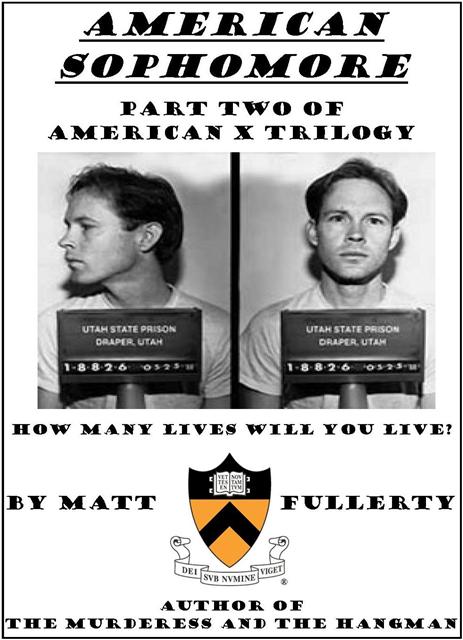
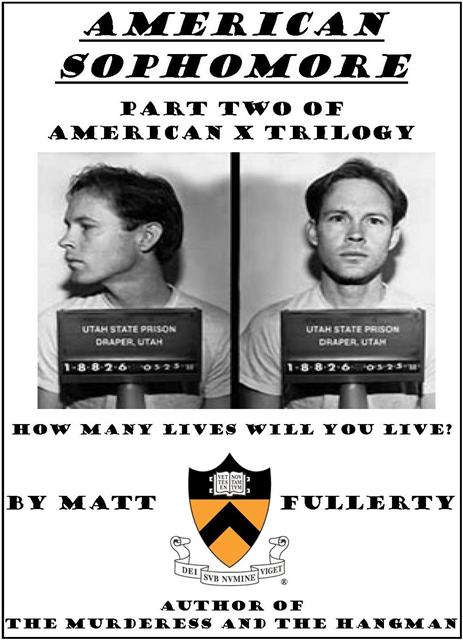
James Hogue, Princeton graduate, athlete, imposter!


Wednesday, June 10, 2009

Matt Fullerty - author fan site!

Matt Fullerty on Facebook


My novel about painting, criminality, and the greatest art forger of the twentieth century!

My novel about painting, criminality, and the greatest art forger of the twentieth century!
Please click the cover!

My novel about London, murder, mayhem, and a female killer!

My novel about London, murder, mayhem, and a female killer!
Please click the cover!

My novel about running, Princeton University, and a conman who lost it all!

My novel about running, Princeton University, and a conman who lost it all!
Please click the cover!

My novel about running, Princeton University, and a conman who lost it all!

My novel about running, Princeton University, and a conman who lost it all!
Please click the cover!

My novel about love, betrayal and chess in New Orleans

My novel about love, betrayal and chess in New Orleans
Please click the book!

My semi-autobiographical novel about a very British education and becoming an American!

My semi-autobiographical novel about a very British education and becoming an American!
Please click the cover!

My novel about London, murder, mayhem, and a female killer!

My novel about London, murder, mayhem, and a female killer!
Please click the cover!